What does holiness mean in the Orthodox Church?
The Greek word hagios and its Slavonic counterpart mean "set apart" and, in the end, "belonging to God". Scripture roots holiness in God Himself: "Be holy, for I am holy" is the command Peter repeats from the Law (1 Peter 1:15-16 listen in the Audio Bible). The Orthodox tradition adds that holiness is not first of all a human achievement. It is the life of God shared with a person, which the Fathers call theosis, or deification. Peter himself says that believers become partakers of the divine nature (2 Peter 1:4 listen in the Audio Bible).
This changes how a saint is imagined. A saint is not a person who never sinned or who has reached a spotless record. He is a person through whom the light of Christ shines, because he has stopped defending himself against it. The tradition is emphatic that the way there passes through repentance. Paul calls himself the foremost of sinners (1 Timothy 1:15 listen in the Audio Bible), and the Church's best-loved saints, such as Mary of Egypt and the thief crucified beside Christ, are remembered chiefly as people who turned.
Because of this, the Orthodox answer to "Are saints perfect?" is mixed. They are perfect in the sense that love has filled them, and imperfect in the sense that they rarely thought so. Saints routinely describe themselves as the worst of sinners, not from politeness but because the nearer they come to God, the more clearly they see what is still unhealed. This is the practical meaning of humility in Orthodox Christianity.
Are all Christians saints?
In the New Testament, yes. Paul writes to the saints in Ephesus, to the saints in Philippi and to the saints in Rome, and he means ordinary members of the churches, with all their faults (see Ephesians 1:1 listen in the Audio Bible). Baptism and chrismation place a person in the Body of Christ and begin a life that is meant to end in holiness (see chrismation, the seal of the Spirit). The Orthodox Church uses "saint" in two senses: the saints we name, whose glorification the Church has declared, and the whole body of believers called to become what the named saints already are.
This is why holiness is not treated as a profession of monks. A mother who stays up with a sick child, a worker who refuses a bribe, a convert who forgives a long-standing wound is walking the same road as the glorified saints, at a less visible stage. The Epistle to the Hebrews pictures believers surrounded by a great cloud of witnesses (Hebrews 12:1 listen in the Audio Bible), and the Book of Revelation shows a multitude from every nation standing before the throne (Revelation 7:9 listen in the Audio Bible). The multitude is much larger than any calendar.
How does the Orthodox Church recognise a saint?
The Orthodox Church says that only God makes a saint. The Church's task is to recognise what God has done. In the first centuries there was no formal procedure: Christians gathered at the tombs of martyrs on the anniversary of their death, and the practice of remembering them spread from there. In time, a bishop's approval of such local veneration became the earliest form of what is now called glorification.
The modern pattern, as described by the Orthodox Church in America, begins with the faithful. People pray to a person, visit the grave, ask for intercession and commission icons. Usually the diocesan bishop is then asked to look into the matter, and a commission researches the person's life and writings and reports to the Synod, which decides whether to glorify. The commission checks that the person's teaching was fully Orthodox and that his life shows the fruit of the Gospel. If the Synod agrees, a memorial service is followed by Vespers and Matins in the saint's honour, an icon is unveiled, a life is published and a day is fixed in the calendar.
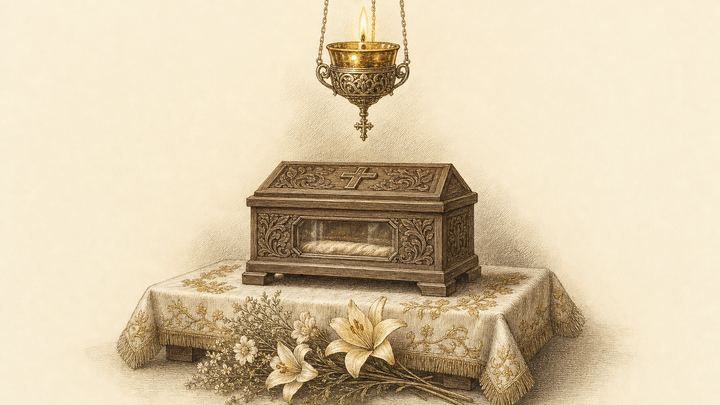
Miracles may prompt the process but are not required. Unlike the Roman Catholic practice of requiring a set number of verified miracles, the Orthodox Church has glorified saints who had no known wonders at all. The Russian Church shows the process on a large scale: from the 1990s a synodal commission examined the cases of those who suffered for the faith under communism, and in 2000 a Council of Bishops glorified Tsar Nicholas II and his family together with many other new martyrs (see the new martyrs and confessors of Russia). Incorrupt relics are not required either (see why the Orthodox venerate relics).
What kinds of saints does the Church honour?
The calendar groups saints by the way they followed Christ. Martyrs witnessed to Him by death, and confessors by suffering short of death. Hierarchs are bishops, such as Nicholas, Basil and John Chrysostom, who guided the Church. Venerable saints are monastics, men and women who gave their lives to prayer and repentance. The righteous are married laypeople or clergy, such as Joachim and Anna, Zacharias and Elizabeth, and in later centuries many others. Others are unmercenary healers, who treated the poor without payment, and those the Church calls equal to the apostles because of their missionary work, such as Constantine and Helen.
Among them are some who might surprise a newcomer. The Church honours fools for Christ, who accepted public contempt as an ascetic path (see holy fools and simple holiness); former criminals; and a number who started out as persecutors. Patriarch Tikhon of Moscow, confessor under the early Soviet state, stands in the tradition of the hierarchs (see St Tikhon of Moscow). The point of the variety is that holiness has no single style: it is the same life in different temperaments and circumstances.
What about the 'unholy saints' and saints of the pew?
A phrase heard in Orthodox circles is that the saints are sinners who did not stop repenting. The tradition has no embarrassment about the saints' faults. St Peter denied Christ three times, and St Paul once persecuted the Church. The lives of later saints record temper, pride and long failures overcome by effort and grace. The Church's usual way of telling such stories is not to excuse the faults but to show what God can do with them.
The same logic gives rise to the idea of saints of the pew: unnamed believers whose holiness is hidden, who attend the services faithfully, pray at home, keep the fasts and care for neighbours. Nobody canonises them, and most never expect to be remembered. The Church's feast of All Saints, kept on the Sunday after Pentecost, honours all who have pleased God, known and unknown. This is a reminder that the calendar is a sample. For restoration after serious failure, which the saints often modelled, see repentance after grave sin.
How should Orthodox Christians relate to the saints?
Orthodox Christians honour the saints; they do not worship them. Worship belongs to God alone, while the saints are honoured as friends of God who are alive in Him and pray for us. The foundation of this practice is the Church's teaching on the communion of saints: the Church includes those on earth and those who have died in Christ. Requests to the saints are simply requests for prayer, like asking a friend (see asking the saints to pray for us).
The most useful way to begin is to learn the lives. Many parishes read the saint of the day at services, and the daily calendar names them (see the church calendar). Choose a saint whose story speaks to you, read how they struggled, and ask for their prayers. Many Orthodox keep icons of their patron saints at home, light a candle on the saint's day, and attend the Divine Liturgy on feast days (see the Divine Liturgy).
Reading the lives of the saints alongside Scripture is a good habit. The Audio Bible is a convenient way to hear the Gospels and the epistles that the saints themselves loved. A priest can help a beginner with the question of which saints to read first and how to pray to them, since the right guidance depends on the person.