What is the one-altar, one-Liturgy rule?
Visit an Orthodox church on an ordinary Sunday and you will find a single Divine Liturgy, attended by the whole parish, at which the priest, and any priests serving with him, receive Communion alongside the people. There is no early Mass for some and a later Mass for others, no rota of services spread across the morning. The usual practice, with limited exceptions, is that one altar hosts one Liturgy in a day, and that a priest celebrates only one Liturgy in a day.
This is a point of custom and church order, not a single dogmatic statement. I should say plainly that there is no canon number I can responsibly cite as its source. The sources consulted do not name one, and the claim sometimes found online that a specific ancient canon decrees it could not be verified. What can be shown is how the practice is grounded: in the Church’s teaching about the unity of the Eucharist, in the early witness of the Fathers, and in the Typikon, which does not provide for two Liturgies on the same day even on a great feast. Understanding the rule means understanding the idea behind it. For the background to that idea see our article on the Eucharist, and for how the Church treats her rules in general, our article on the Typikon.
What does Scripture say about one bread, one body?
Paul’s argument in First Corinthians is the root: “Because there is one bread, we who are many are one body, for we all partake of the one bread” (1 Corinthians 10:17 listen in the Audio Bible). The Eucharist is not a private possession of each believer, still less of each priest. It is the act in which the many become one body. Multiplying separate celebrations as if each were an independent event obscures that logic.
The New Testament pictures the same thing in the life of the first community. In Acts the believers devoted themselves “to the apostles’ teaching and fellowship, to the breaking of bread and the prayers” (Acts 2:42 listen in the Audio Bible), and at the Last Supper Christ gave the bread with the words “Do this in remembrance of me” (Luke 22:19 listen in the Audio Bible). What he gave, he gave to the table of the disciples together. The Church has understood the command as an act of the gathered community (see also Paul’s account of the Supper in 1 Corinthians 11:23-26 listen in the Audio Bible), and the rule of one altar and one Liturgy is a way of keeping that shape visible.
What did the early Church teach about one Eucharist?
Around the beginning of the second century, Ignatius, bishop of Antioch, wrote to the Church in Philadelphia: “Take heed, then, to have but one Eucharist” (Philadelphians 4). He goes on to say that there is one flesh of the Lord, one cup that unites us in his blood, one altar, and one bishop with the presbytery and deacons. The wording belongs to the earliest generation after the apostles, and it already links the Eucharist, the altar, and the bishop.
The point is not that nothing may ever be repeated, but that the Eucharist is the sign of one Church gathered with its bishop. Local communities were small enough for the whole city’s Christians to meet together. As churches multiplied, the bishop’s authority was extended to the priests he sent out, and each Liturgy was understood to belong to that one communion (Romans 12:5 listen in the Audio Bible says that we, though many, are one body in Christ). The one altar and the one Liturgy became the visible form of that unity. You can read more about the bishop’s role in our article on apostolic succession.
What is the antimension, and why does it matter?
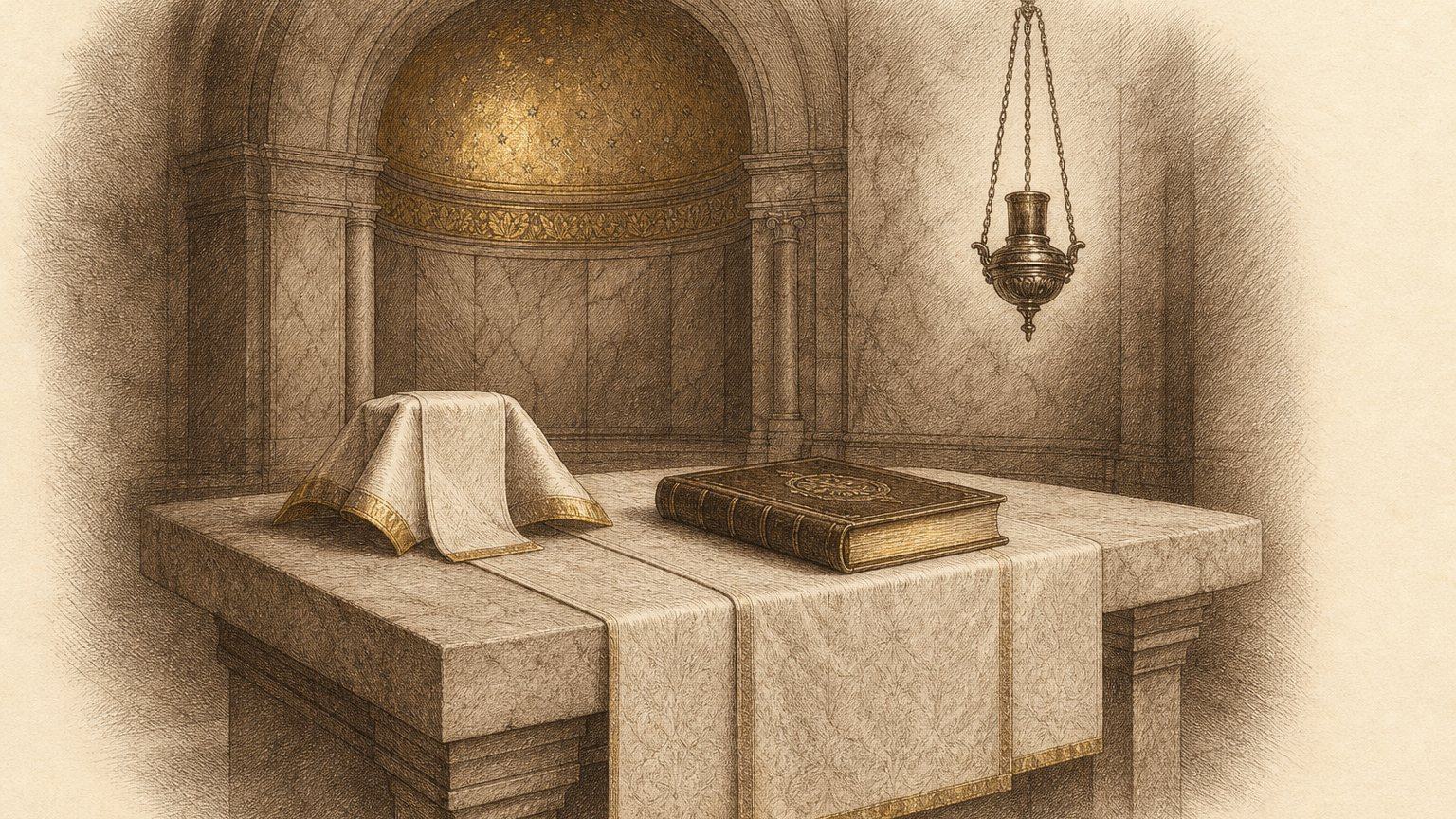
The antimension, from the Greek meaning “instead of the table,” is a rectangular cloth of linen or silk laid on the altar. It typically shows the entombment of Christ with the four Evangelists, and a small relic is sewn into it. It carries the signature of the diocesan bishop, and that signature is the heart of the matter: it shows that the priest serves with the bishop’s authority and in communion with him. A church without an antimension cannot normally celebrate the Liturgy until one is provided.
The cloth also explains how the rule works in practice. Where a second Liturgy is truly needed, as in some large cathedrals, an auxiliary altar with its own antimension is used. In that case the arrangement is still respecting the principle: it is a second altar, not a second Liturgy on the first. The antimension thereby ties each celebration, however many there are, back to the bishop and to the one Church.
Can several priests serve one Liturgy?
Yes, and this is the other half of the picture. Concelebration is a normal and joyful part of Orthodox worship: several priests and deacons may serve together at one altar, with the senior celebrant presiding. A bishop concelebrates with his priests, and visiting clergy are welcomed to the altar. Rather than each priest serving separately in turn, they serve together, and the people receive Communion together.
This is what the rule protects. Orthodox theologians have long noted that the multiplication of private celebrations pulls the Liturgy away from the assembly, while concelebration holds it together. It also puts the question in perspective: it is not that the Church wishes to restrict the priest, but that it regards the Eucharist as the act of a community in which clergy and laity each have a part. A priest who serves a Liturgy has, in effect, celebrated for the people entrusted to him.
Are there exceptions?
There are, and honest accounts admit them. In some large cathedrals and in the Russian tradition, more than one Liturgy has been served in a day, with the bishop’s blessing, particularly where the number of worshippers or of priests made another arrangement impractical. The Russian liturgical scholar Nikolai Uspensky noted that the Typikon itself does not know of two Liturgies in one day, even on a great feast, yet he acknowledged that Russian practice nonetheless includes them. Such cases are exceptions, regulated by the bishop, and not a change in principle.
Other practical situations call for pastoral judgment. In regions where the Church is small and priests are few, a priest may have to travel, and the question of how many times he can serve in a day is one for his bishop. Several parishes sharing one building may use separate altars or different times, and the arrangement is usually settled with the diocesan bishop. What matters in all of this is that the exception is by authority and out of need, and does not become the rule through convenience.
What does it mean for the ordinary worshipper?
The practical lesson is that Sunday belongs to the whole parish together. If you are able to attend the Liturgy, the Church’s invitation is to be there for the whole of it, to pray with the others, and to receive Communion when you have prepared, not to look for a service that suits your schedule. The unity of the Eucharist is partly expressed in the unity of those who come. Details of service times are on the Liturgy page, and the rhythm of the year is shown in the Church calendar.
Some find it a discipline to arrive for the beginning and stay to the end. It is also a gift: when the entire community stands before one altar, no one is a spectator at someone else’s service. Many parishes also hold a shared meal after the Liturgy, which carries the same instinct into daily life; for what to expect on a first visit, see our guide to parish life. To hear the passages about the Last Supper and the first Christian community, you can use the Audio Bible.