What does a Sunday at an Orthodox church look like?
The centre of Orthodox parish life is the Divine Liturgy, the Sunday celebration of the Eucharist. Most parishes use the Liturgy of St John Chrysostom, a service that has been served in essentially this form for well over a thousand years. It is sung almost from beginning to end, usually by a choir and without instruments, and it commonly lasts an hour and a half or more, though lengths vary from parish to parish.
The service falls into two broad parts. The first, sometimes called the Liturgy of the Word, includes litanies, hymns, the reading of the Epistle and the Gospel, and usually a sermon. The second, the Liturgy of the Faithful, centres on the offering of the bread and wine, the Creed, the Lord's Prayer and the reception of communion. Many parishes serve the Hours or Matins first, so people arrive and settle gradually rather than all at once.
Afterwards the priest usually offers the cross to be kissed and distributes blessed bread, called antidoron. Anyone may take it; it is a sign of fellowship, not communion. In many parishes the community then sits down to tea or a meal, often called coffee hour. For a first-time visitor this is often the most welcoming part of the morning, and you are warmly encouraged to stay for it. The early Christians are described in just this way: they "devoted themselves to the apostles' teaching and fellowship, to the breaking of bread and the prayers" (Acts 2:42 listen in the Audio Bible). For the parish's own services, check the services page and the church calendar.
What should I wear, and when do people stand?
Dress modestly and as you would for an important occasion: covered shoulders and knees are a sensible rule of thumb. In many Orthodox parishes women cover their heads and men uncover theirs, but customs differ and visitors are not expected to match them; if in doubt, watch what others do or ask. Switch off your phone, and leave food and drink outside.
Orthodox worshippers stand for most of the service, as an expression of readiness before God, although many churches have chairs or benches along the walls. Sitting is not a fault. The elderly, the unwell, pregnant women and anyone who is tired may sit at any time, and in many parishes people sit during the readings and the sermon. Standing is the custom, not a test. What matters more is attention, and a visitor who stays quietly present for the whole service is already worshipping well.
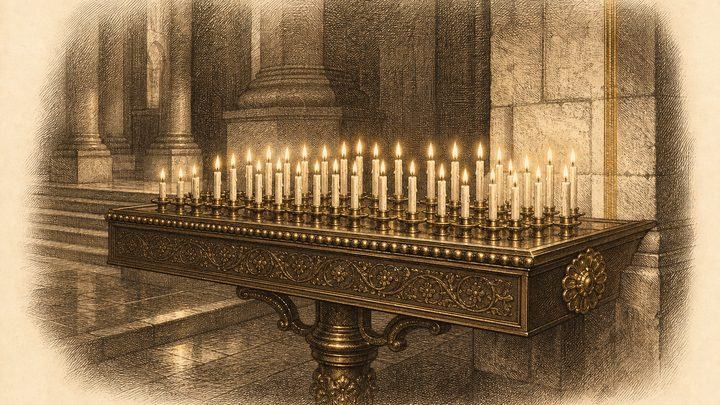
You will see people crossing themselves, bowing and moving about the church. They light candles, kiss icons and make small prostrations. The sign of the cross is made with the first three fingers of the right hand joined together, from forehead to chest and from the right shoulder to the left. If you are not Orthodox, you do not have to imitate any of this. Joining in a custom that you do not yet understand is not required, and nobody will think less of you for standing still. If you are curious, the article on candles and the article on icons explain what the gestures mean.
Who may receive communion, and how do people prepare?
The Orthodox Church receives communion as the Body and Blood of Christ, and has always asked that it be approached with care. Paul warns that whoever eats and drinks without discerning the body eats and drinks judgment on himself (1 Corinthians 11:27-29 listen in the Audio Bible). For that reason communion is given to baptized and chrismated Orthodox Christians who have prepared. If you are visiting and are not Orthodox, please remain in your place when the chalice comes out; this is not a rebuke but a statement of what communion means. You are still welcome to take the blessed bread afterwards. For what the Church believes about the gifts themselves, see the article on the Eucharist.
Preparation is spiritual before it is dietary. The Orthodox Church in America's guidance on communion lists repentance, a sincere desire to change one's life, forgiving others, prayer and reflection, and approaching the chalice in faith and love. Fasting before communion, at the least from midnight, is the common rule for Orthodox adults; longer pre-communion fasts and the frequency of confession vary with local custom and the guidance of one's own priest. Ask your priest rather than guess. For the shape of confession itself, read the article on confession, and for the seasons and days of fasting, see the fasting page.
What about language, children and feeling like a stranger?
Language is the first thing many visitors worry about. Orthodox parishes around the world serve in many languages, and in a multinational city a single parish may use two or more in one service. Do not be discouraged if you miss words. The service is sung prayer, and many people simply listen, as they would to music, until the words begin to become familiar. A printed order of service, or a conversation with someone beforehand, helps considerably. If you want to prepare, hearing the Gospel and Epistle readings in advance through the Audio Bible means you will recognise them when they are read.
Children are normal members of an Orthodox congregation. They are baptized and chrismated as infants, they receive communion from the first months, and they are present in church, often walking about or whispering. A parish that expects absolute silence from toddlers has misunderstood something about the Church. If you bring a young child, no apology is needed, though a quiet corner near the back is a considerate choice.
Everyone feels like a stranger at first. The pattern is unfamiliar, the movements seem rehearsed, and others appear to know what to do. Nearly everyone in the room once stood where you are standing. Give it several visits before deciding what you think.
How is an Orthodox parish a family, and how do I join?
A parish is not a congregation of consumers. In the New Testament the Church is the household of God (Ephesians 2:19 listen in the Audio Bible), and the author of Hebrews urges believers not to neglect meeting together (Hebrews 10:25 listen in the Audio Bible). The psalm sung by pilgrims going up to Jerusalem, "I was glad when they said to me, let us go to the house of the Lord", is numbered Psalm 121 in the Septuagint listen in the Audio Bible and 122 in most English Bibles, and is a fair description of the mood in which people come to church. Christ promised that where two or three are gathered in his name, he is there among them (Matthew 18:20 listen in the Audio Bible). Over time a parish becomes a household of its own: people share meals, bring food to the sick, help newcomers settle, and keep one another company through illness, bereavement and ordinary weeks.
To join, you do not sign anything. Come regularly, speak to the priest, and say what you are looking for. A person who has never been baptized is prepared for baptism over time, and a Christian baptized elsewhere may be received by chrismation or, in some cases, baptism, depending on circumstances and the priest's judgment. See what happens at baptism and the seal of the Spirit. Many people attend for months before deciding, and nobody will press you.
If you have questions about faith itself, an Orthodox parish expects them. A good place to begin with prayer at home is the guide to Orthodox prayer for beginners.
What is the parish at Kovan, Singapore, like?
The Parish of the Dormition of the Mother of God in Kovan belongs to the Russian Orthodox Church, within the Diocese of Singapore and the Patriarchal Exarchate of South-East Asia. According to the parish website, the parish rents its premises and receives no government funding. Its own website is also the place to confirm anything practical: this article deliberately gives no times and no address, because they can change and should be taken from the source. Use the services page and the church calendar for dates and times.
The parish's article on confession mentions that the priest at Kovan can be reached through the parish website, that confession there is heard in Russian and in English, and that a conversation over tea after the Liturgy is a perfectly normal way to begin. That is a reasonable invitation to take at face value. You do not have to commit to anything to come and see.
How can I help, and what does a parish cost to keep going?
Parishes run on volunteers. People bake the prosphora, the bread used in the Liturgy, read, sing, clean, cook for the meal, look after the candle desk, keep accounts and welcome visitors. The simplest way to help is to ask what is needed and do one small thing regularly.
A parish also runs on money. The Kovan parish states that about S$18,000 is needed each month for the rent and running costs, and that it receives no government funding. Those who find the readings and services useful are invited to help keep the parish going through the support page. Giving is never required of a visitor, and nobody is expected to give beyond their means; it is simply the way a community pays for the roof over its prayers.
The gift of time and attention is often the largest of all. Come, stand quietly, listen, and come again.