What does a lit candle mean in an Orthodox church?
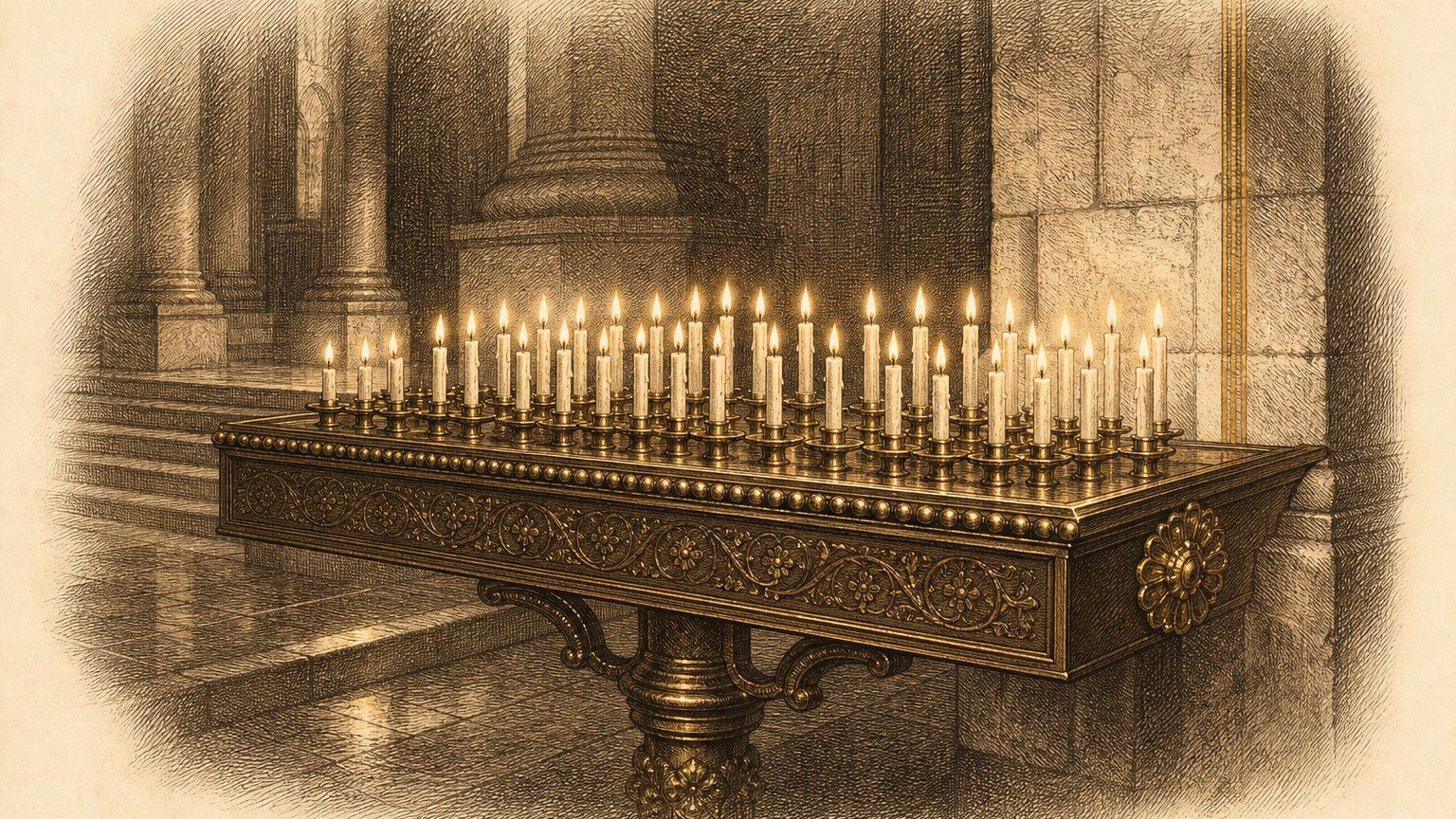
Walk into an Orthodox church and you will see people stop at a brass stand near the door, put a few coins into a box, take a thin taper, light it from another flame, and set it upright in the sand.
The Church teaches that a candle is an offering made by a person who cannot stay in church all day. You bring something you have bought or made, and it goes on burning in front of the icon, praying, so to speak, in your place while you carry on with your errands. It stands for faith in God's presence, for hope in his help, and for love towards the people you are praying for.
The flame also points beyond itself. Christ says of himself, "I am the light of the world" (John 8:12 listen in the Audio Bible), and he tells his disciples that they are the light of the world too, a city on a hill that cannot be hidden (Matthew 5:14 listen in the Audio Bible). A candle burning among the icons is a small, visible reminder of both sentences: the Light that comes from God, and the light that his saints and ordinary believers are called to reflect.
Why beeswax, and why does the material matter?
The traditional candle of the Church is made of pure beeswax. Practically, beeswax burns longer and cleaner than paraffin, produces little smoke and soot, drips less, and gives off a faint scent of honey. That is why many parishes ask for it, or at least prefer it for the candles used in the sanctuary and at services.
Writers in the Orthodox tradition also find a meaning in it. The wax, made by bees from the nectar of flowers, was often taken as a picture of the pure flesh that Christ received from the Virgin Mary; the wick as his soul; the flame as the divinity that fills both. Treat this as a pious and ancient image rather than a dogma. It is a way of looking at an ordinary object and seeing the mystery of the Incarnation, which you can read about in why Orthodox Christians honour the Theotokos.
A candle also teaches by how it behaves. It gives light only by being consumed. Many preachers have said that this is what a Christian life is meant to look like: not hoarding oneself, but burning down in love for others. The psalmist says that God's word is a lamp to his feet and a light to his path (Psalm 118:105 listen in the Audio Bible).
Where do I put the candle: for the living or for the departed?
Most churches have two kinds of stand, and it matters to use the right one. The large stand placed before an icon, usually the icon of Christ, the Mother of God or the saint of the day, is for the living. You light a candle there for your own needs and for the health and salvation of family and friends. Many people also light one for the saint to whom they are praying and ask for their prayers; the background to this is explained in asking the saints to pray for us.
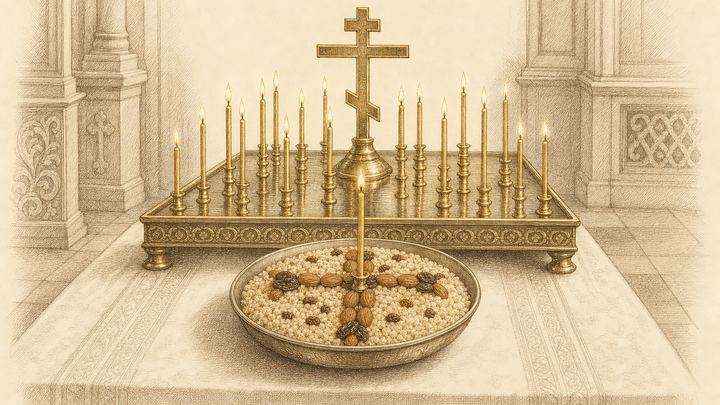
The second stand is the memorial table, which in Slavic parishes is called the kanun (or panikhidny stol). It is usually a small square table or stand with a crucifix and a place for candles, and it is set apart from the icons. Candles for those who have fallen asleep in the Lord go there.
The rule is simple but kind to remember: the living go before the icons, the departed at the kanun. The reason is not that the departed are far from God, but that the Church prays for them in a particular way, as why Orthodox Christians pray for the dead explains. For what happens at a funeral and at the memorials that follow, see the Orthodox funeral and remembering the departed.
How do I light a candle, and what do I say?
There is no rigid ritual, and visitors are not expected to know one. A common way is this. Make your offering at the candle desk. Approach the icon, make the sign of the cross, and, if you wish, kiss the icon, which Orthodox Christians do as a sign of love for the person depicted (see why Orthodox churches have icons). Take a candle, light it from one already burning, set it firmly in the sand, cross yourself again and pray.
The prayer can be in your own words: thanks, a request, the names of the sick or troubled. A short form often used for the living is simply "Lord, have mercy" and the person's name. For the departed one says quietly something like "Remember, O Lord, thy servant N." and "Lord, have mercy", naming the person. For a wider guide to praying at home and in church, see how to pray in the Orthodox way.
Candles may also be bought and lit during a service, but it is best to do so before it begins or after it ends, or at a moment when no one is reading or singing, so as not to move about during the Gospel or the Eucharistic prayers.
Where else do candles and lamps appear in Orthodox worship?
Candles are woven into the year. At Pascha, in the night service before the Liturgy, the church is dark until the priest brings out a flame and the whole congregation lights their own candles from it, passing the light from hand to hand as the hymns announce the Resurrection. People often carry the lit candle home and use it to light the lamp before their family icons. You can read about how the services run on our page on the Divine Liturgy.
On 2 February on the Julian (Church) calendar, which is 15 February on the civil calendar, the Church keeps the Meeting of the Lord, when Simeon takes the infant Christ in his arms and calls him a light for the nations (Luke 2:32 listen in the Audio Bible). In English-speaking countries this feast is often called Candlemas, and in many Orthodox parishes candles are blessed on that day. Check the church calendar for the date.
Then there is the small oil lamp, the lampada or vigil lamp, that hangs or stands before an icon at home and in church. It echoes the Old Testament command that pure oil be brought so that a lamp might burn before the Lord continually (Exodus 27:20 listen in the Audio Bible). Many families keep a lampada burning on Sundays and feast days, or in times of illness or special need. The lamp is a quieter sibling of the candle: not an offering of the moment, but a steady watch.
Are candles a donation to the parish, and are they required?
A candle is not a ticket to be paid for, but it is also not entirely free: the church buys its candles, and the money you put in the box helps cover wax, oil, incense, heating or cooling, and the other costs of keeping a parish open.
They are not required, and nothing in your prayer depends on them. The Church knows that the heart of worship is the Liturgy and the Eucharist, and that prayer in private is just as real without a flame. If you wish to give more generally, you will find ways to do so on our donation page.
One more gentle point. Never remove or snuff someone else's burning candle to make room for your own. If the stand is full, the usual custom is to move gently aside, or to wait until the person responsible for the stand tidies away the burned-down ends.
Practical notes for a tropical country: heat, wax and fire safety
Singapore is hot and humid all year, and that affects candles in practice. Beeswax softens in heat, so thin tapers can bend and fall over, especially if they are left in a hot bag or a car. Keep your candles in a cool place and set them deeply in the sand.
Fire safety is part of reverence. Keep sleeves, hair and paper away from flames; do not leave a burning candle at home unattended; and keep children's hands steady and supervised. If you light a candle or a lampada at home, place it on a stable, non-flammable surface, away from curtains and fans, and put it out before you leave the room for long or go to sleep.
Finally, if you wish to learn more, come to a service. The easiest way to understand a candle is to see one used at Vespers or at Pascha, with the church around you, the icons shining in the light, and the words of the hymns explaining what the flame stands for. You are welcome to listen to the readings in advance in the Audio Bible, and to ask the priest or a parishioner anything you would like to know.