Why a Saturday
The Church has always prayed for her departed, and it sets aside particular days when she does so together. Saturday is the natural day: it is the day on which Christ lay in the tomb, and the day the Church keeps in the weekly cycle for the departed and for all the saints.
These days are called parental Saturdays (in Russian, roditelskie subboty), because most people first think of their parents and grandparents. The name is wider than that. The Saturday memorial is made for everyone who has died in the faith, including those who have no one left to remember them, and for those whose names no living person knows.
The Saturdays of the year
Different Saturdays carry this memorial. The Saturday before Meatfare Sunday (the Sunday of the Last Judgment) is called the Ecumenical Memorial Saturday, and the Saturdays of the second, third and fourth weeks of Great Lent are kept as memorial days. Trinity Saturday, before Pentecost, is another. In Slavic practice Radonitsa, on the Tuesday after Thomas Sunday, is the first full memorial after Pascha, and Dimitriev Saturday closes the autumn.
Dates move with Pascha, except for Dimitriev Saturday, which is tied to a fixed feast. Check the parish calendar for the exact dates in the current year, and bring any questions to the priest.
Dimitriev Saturday
Dimitriev Saturday is the Saturday before 26 October on the Church calendar, the feast of the holy Great Martyr Demetrius of Thessalonica. On the civil calendar this is 8 November, so in 2026 the memorial falls on Saturday 7 November.
In Russian tradition it took its name and its form after the fourteenth century, when Grand Prince Dmitry Donskoy, having won the battle of Kulikovo, had the fallen soldiers commemorated by name and, according to the tradition, prayed for them on the Saturday before the feast of his patron saint. The custom of a general memorial at that time of year then spread across the Russian Church. For most of the faithful, though, the reason is simple and older than the history: the Church remembers those who have died, and this is one of the days set for it.
What happens in church
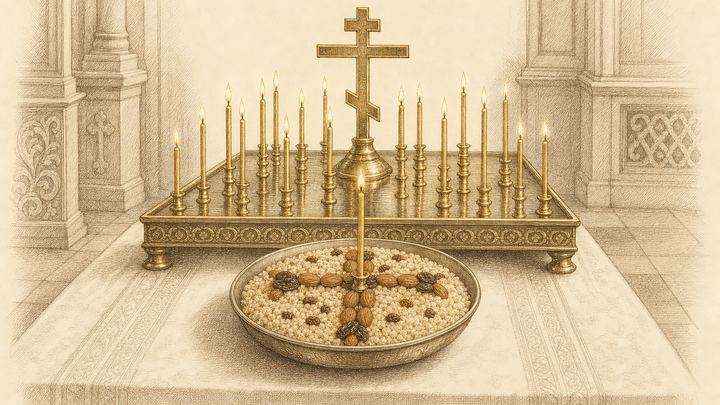
The Liturgy is served in the morning, and in the Divine Liturgy the departed are remembered during the proskomedia, when the priest lifts out a particle of bread for each name on the lists that the faithful bring. After the Liturgy a panikhida, the short memorial service, is usually served, often with a table of kolyva (boiled wheat with honey) in front of the cross.
On the eve, the Friday evening, a memorial service with the Great Panikhida is traditionally served. At the parish, ask the clergy or look at the schedule for the times; they can differ year to year.
How to take part
Write a list of the departed that you want remembered, giving their baptismal names in the genitive case ("for the repose of Ivan, Maria"), and give it to the candle desk or to the priest. Only Orthodox Christians are named on the lists for the proskomedia. For someone who was not baptised, or not Orthodox, you can pray privately, and the priest can advise.
Come to the Liturgy if you can, and stay for the panikhida. At home, light a candle, read the 17th kathisma of the Psalter if you know it, or simply say "Remember, Lord, the soul of Your servant" and the names. Giving to the poor in their memory is an old and good practice.
What this does for the living
The Church teaches that prayer for the departed is heard and helps them, and also that nobody in the Church is ever cut off from anybody else. Those who pray for the dead are reminded that they will die, and that love does not stop at that boundary. That is why these Saturdays are sombre without being hopeless: the services keep returning to the Resurrection.