What is Theophany, and why is water blessed on that day?
Theophany, also called Epiphany, is the feast that celebrates the baptism of Jesus Christ by John in the river Jordan. The Gospels tell how Christ came from Galilee to be baptised (Matthew 3:13 listen in the Audio Bible), how the heavens opened, and how the Spirit descended like a dove while the voice of the Father spoke from heaven (Mark 1:9 listen in the Audio Bible). The Orthodox Church sees in this one scene the revelation of the Holy Trinity, which is why the feast is called Theophany, "the manifestation of God".
The date is 6 January. Churches that use the Julian calendar, including the Russian Orthodox Church and our parish, keep it on what is 19 January in the civil calendar, and the eve falls on 18 January. In the Orthodox Church this is one of the twelve Great Feasts, and it was at one time the day when new Christians were baptised. You can check the date and the services each year on the church calendar.
Why water? Because Christ entered it. The Church's hymns say that when the Lord went down into the Jordan he did not need cleansing; rather, he sanctified the waters and made them a means of blessing for the whole world. That is the reason behind the Great Blessing of Water: a prayer that what Christ touched at the Jordan may be given again to his people.
What happens at the Great Blessing of Water?
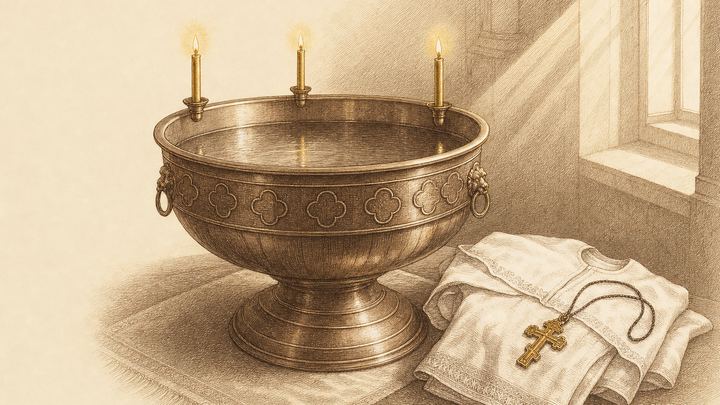
The Great Blessing of Water (in Greek, the Megas Hagiasmos) is served twice. The first time is on the eve of the feast, 18 January, after the Liturgy of Saint Basil the Great, which is combined with Vespers; the second is on the feast day itself, usually after the Divine Liturgy. In many parishes the priest and people go out in procession to a river, a lake or the sea, or gather around a font in the church.
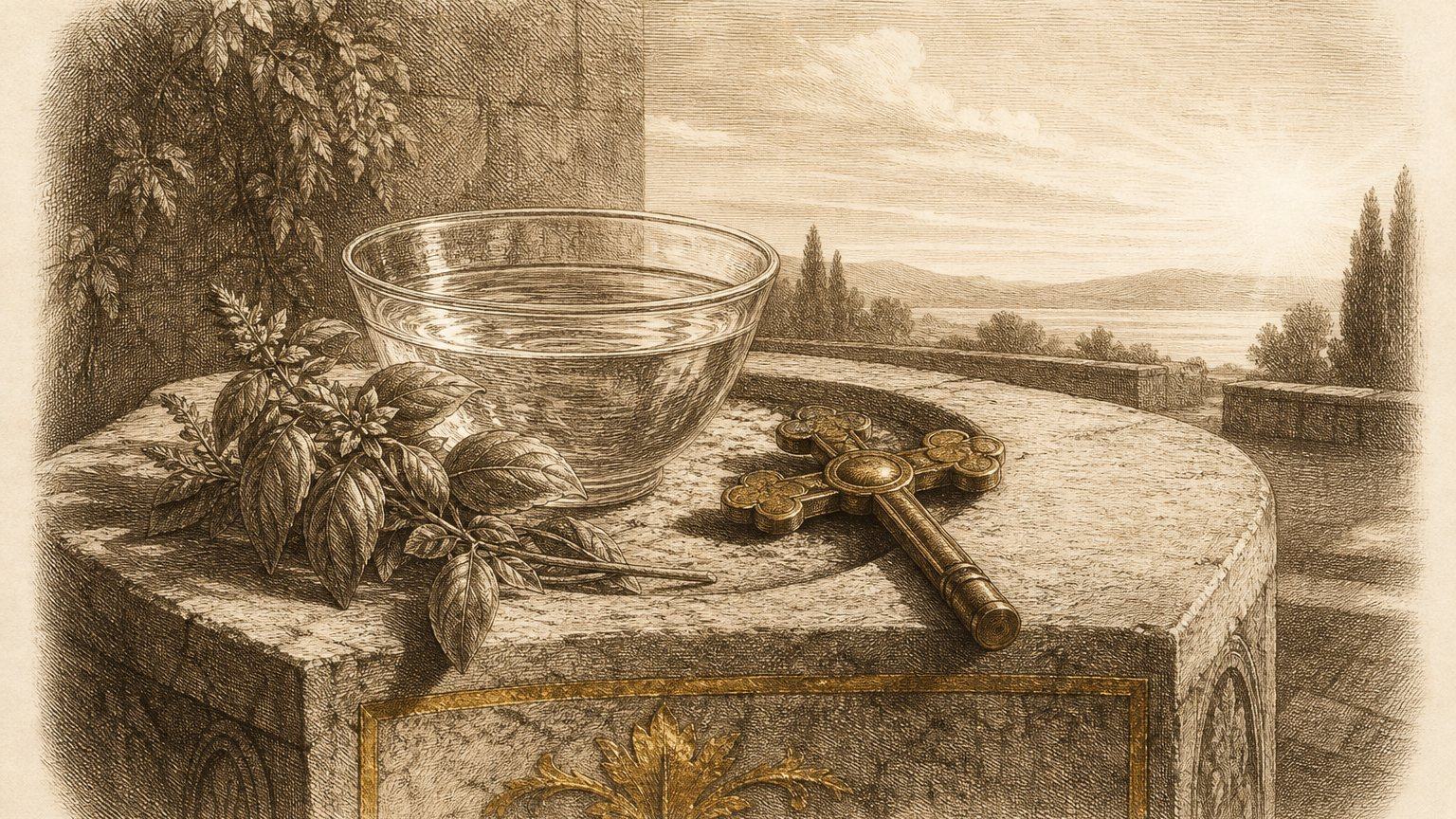
The service contains readings from the Old Testament and the Gospel, litanies, and a long prayer addressed to Christ. The prayer is attributed to Patriarch Sophronius of Jerusalem in the seventh century. It asks God to send down the grace of the Holy Spirit upon the water. The priest then blesses the water by making the sign of the cross over it, and by dipping the cross into it three times while singing the troparion of the feast. The people are then sprinkled and receive the water.
In the tradition the Old Testament is full of water as a sign of life and cleansing. In Psalm 28 the voice of the Lord is "upon the waters" (Psalm 28:3 listen in the Audio Bible), and the prophet Isaiah speaks of drawing water with joy from the wells of salvation (Isaiah 12:3 listen in the Audio Bible). If you wish to hear these texts read, you can find them in the Audio Bible. The blessing is closely related to the sacrament of baptism, which is described in what happens at an Orthodox baptism.
What is the Lesser Blessing of Water, and when can I ask for it?
The same prayer is not served all year round, but the Church has a shorter form, the Lesser Blessing of Water (the Small Sanctification). A priest may celebrate it at the beginning of each month in some traditions, before a journey, before a new venture, or when someone asks for it at home or in church. It is also the rite used in the blessing of homes.
If you have no Theophany water, or you have run out, you can ask the priest to bless water for you after a service. The two forms are not rivals. Both ask that God sanctify the water for the benefit of those who use it. The great blessing is the one celebrated by the whole Church on the feast, and the lesser blessing is available whenever it is needed.
How do Orthodox Christians use holy water at home?
The custom is to keep the water in a clean bottle near the home icons, and to take a few sips, with prayer and reverence, in the morning before eating. Many people also take it when they are ill, before a journey, in times of anxiety, or before important events. The water is also used to sprinkle the rooms of the house, usually with a small brush or sprig, while praying the Trisagion or the troparion of the feast: "When thou, O Lord, wast baptised in the Jordan..."
In some families a few drops are added to a glass of ordinary water, or a bowl of holy water is kept near the door. If you use it, you can say a short prayer of the Church, in which one asks that the gift of the holy water bring healing to the soul and body.
Those who are unwell should of course still see a doctor; holy water is not a medical treatment. And those who have not been baptised can still ask for holy water and drink it with respect. The Church encourages a relation of trust and of thanksgiving, not of fear. For the wider habit of daily prayer, see how to pray in the Orthodox way.
Is holy water magic? What does the Church actually teach?
No. The Church teaches that all of creation was made good by God, and that matter can be a vehicle of divine grace. This is the same logic behind the icon, the bread and wine of the Eucharist, the oil of anointing, and the Chrism of confirmation. In baptism, Christ says that one must be born "of water and the Spirit" (John 3:5 listen in the Audio Bible). The water of the feast is not a charm; it is creation offered back to God and returned as a blessing.
Saint Paul writes that the whole creation waits with eager longing to be set free (Romans 8:19-21 listen in the Audio Bible). Orthodox Christians see the blessing of water as a small sign of that hope, a promise that the material world is destined for transfiguration. This is the sacramental view of the world also found in the Eucharist and the real presence.
At the same time the Church warns against treating holy water mechanically. Its benefit depends on prayer, faith and reverence, and not on the water alone. It does not guarantee success, it does not replace repentance or the sacraments, and it is wrong to use it as a charm or an "insurance policy". The pravoslavie.ru article on holy water summarises this attitude well. If you are uncertain how a custom should be understood, a priest is the person to ask.
How long does holy water keep, and why does it stay fresh?
Many Orthodox Christians report that Theophany water remains clear and fresh for a year or longer, even when stored in an ordinary bottle in a cupboard. The tradition has long taken this as a sign of the Spirit's blessing. Others point to ordinary explanations, such as clean containers and the absence of light. The Church does not teach a scientific claim here, and you may hear both explanations in a parish.
What the Church does ask is that the water be treated with care. Keep it in a clean bottle, away from direct heat, and use it with reverence. In a tropical climate like Singapore's, keep the bottle sealed and in a cool, dark place, and refresh it from the next Theophany.
How do I treat leftover water, and what about the river services?
Because it has been blessed, the water is treated with respect and is not simply poured down the drain. The usual advice is to pour what is left on the roots of a plant or tree, or on clean ground where no one will walk, rather than into the drains or the rubbish. Candles are also lit at these services; see why Orthodox Christians light candles.
The immersion services, in which people go out to a river, lake or sea and some immerse themselves, are a popular custom in Russia and elsewhere, often in freezing water. They are a beautiful expression of the feast, but they are not a requirement, and no one should risk their health for the sake of it. In a warm climate, the same joy can be found simply in receiving the blessed water and taking it home.
If you would like to attend the Great Blessing, come to the services on 18 and 19 January, and bring a clean bottle. Details of the timetable are on our liturgy page. And if you are curious about the other water and anointing of the Christian life, you may also like to read chrismation, the seal of the Spirit and how to pray in the Orthodox way.