What does it mean to become Orthodox?
To become Orthodox is to be received into the Church that traces itself to the apostles through an unbroken line of bishops, as explained in apostolic succession explained. It means entering a community, not adopting a set of opinions. A person who joins is baptised into Christ's death and resurrection (Romans 6:3 listen in the Audio Bible), and is clothed with Christ (Galatians 3:27 listen in the Audio Bible), and takes a place at the common chalice.
The Church's own words for this are plain. The risen Christ commands his disciples to make disciples of all nations, baptising them in the name of the Father, the Son and the Holy Spirit (Matthew 28:19 listen in the Audio Bible). On the day of Pentecost, Peter tells those who ask what to do to repent and be baptised, and promises the gift of the Holy Spirit (Acts 2:38 listen in the Audio Bible). The Gospel according to John speaks of being born of water and the Spirit (John 3:5 listen in the Audio Bible).
It follows that becoming Orthodox is not a decision to be hurried. The Church has asked adults to prepare for baptism since the earliest centuries; Cyril of Jerusalem, in the fourth century, addressed those who had enrolled for baptism and urged them to use the weeks of preparation for repentance and listening, and to come with a sincere will rather than curiosity.
What are the first steps?
Begin by coming to the services. Most priests ask enquirers to attend the Divine Liturgy for several weeks, at least, before any decision, so that they can see how the Church prays. One parish guide suggests three to four weeks as a minimum. You are welcome to stand through the service, to listen and not to receive Communion; look at the liturgy page for times and for what to expect.
Then speak with the priest. Tell him your story, your questions and your difficulties, and ask him anything. He will not expect you to be convinced about everything; he will want to know whether you are willing to learn and to belong. You may also meet other parishioners and, if possible, someone who became Orthodox as an adult.
Read and listen at the same time. The Gospels and the Psalms are the heart of the Church's worship, and you can hear them in the Audio Bible. The Church's life is lived more than it is argued, so give your attention to prayer, and see how to pray as an Orthodox Christian for a simple beginning.
What is the catechumenate?
A catechumen is a person who is being taught the faith before baptism or reception. The word comes from the Greek for "instruct", and the catechumenate is an ancient institution; the Liturgy still contains a dismissal of the catechumens, a reminder of the days when they left before the Eucharist.
In practice, the catechumenate means regular instruction under the priest, a deacon or an experienced teacher, and a gradual entry into Orthodox life: the Liturgy, the Psalms, the fasts and feasts, and the habit of daily prayer. One parish guide gives a typical length of six months to two years, depending on a person's background. The pace depends on the priest, the parish and the person, and there is no fixed number of lessons.
In many parishes the priest will enrol you as a catechumen with a short prayer, sometimes called the making of a catechumen, during which you are signed with the cross. From then on you may take part in the first part of the Liturgy and in the parish's life. Along the way you will study the Creed, which came out of the early councils; the pillars of Orthodox belief are explained in what the ecumenical councils are.
What happens at baptism and chrismation?
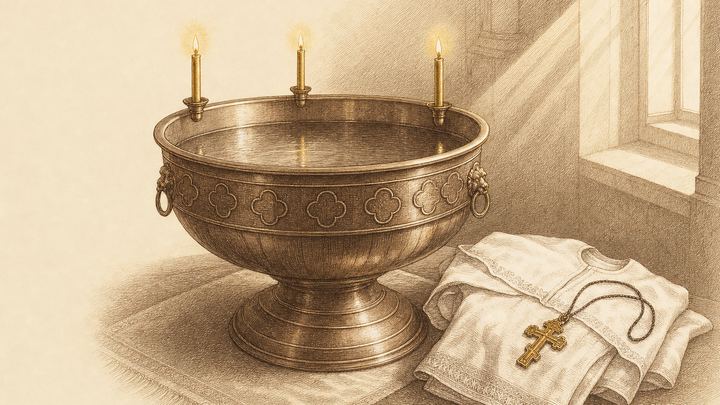
If you have never been baptised, you will be received by the three mysteries of Christian initiation, which are celebrated together: Baptism, Chrismation and Holy Communion. At baptism the priest immerses you three times in the water, in the name of the Father, the Son and the Holy Spirit. After that you are dressed in a white garment and given a cross to wear. The full story is told in what happens at an Orthodox baptism.
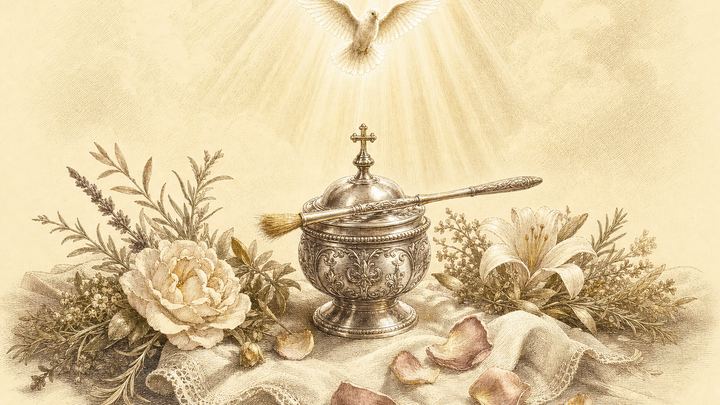
Chrismation follows at once. The priest anoints the newly baptised with the holy chrism, which has been consecrated by the bishop, on the forehead, eyes, nostrils, lips, ears, chest, hands and feet, saying "The seal of the gift of the Holy Spirit". This is the Orthodox equivalent of the Pentecost of the apostles, and is described in chrismation, the seal of the Spirit.
Then you receive your first Communion, often at the same Liturgy. The hair is cut in a small sign of offering, and the newly illumined walk round the font with the priest. Before baptism, the Church normally invites an adult to make a confession of past sins, which is described in confession in the Orthodox Church. The day is usually quiet, with family and a few friends.
What if I was already baptised in another church?
The answer varies, and it is decided by your priest and bishop. The Council in Trullo, in its canon 95, recognises three ways of receiving a person into the Church: baptism, chrismation or a confession of faith. Which one applies depends on the church the person comes from and on the practice of the Orthodox jurisdiction.
In the Russian tradition, as summarised by one Orthodox study of contemporary practice, Trinitarian Protestants and Roman Catholics who have not been confirmed are generally received by chrismation, Catholics who have been confirmed are generally received by a confession of faith, and those from non-Trinitarian groups are baptised. Greek practice has a different history, and in some places, especially on Mount Athos, baptism is still given to converts as a matter of strictness. The Antiochian and OCA practices described in the same study usually use chrismation for Trinitarian Christians.
This variety is not a sign of confusion; it reflects different pastoral judgments, called economy and strictness in Orthodox theology. If you were baptised as a child, bring the certificate if you have it and ask the priest what the practice of his jurisdiction is. Do not take offence if he proposes a path you did not expect.
Godparents, a new name and a patron saint
A godparent, or sponsor, is an Orthodox Christian who stands with you at baptism, vouches for your sincerity and promises to pray for you. He or she should be a communicant member of the parish, and many adult converts choose someone from the community who has helped them. Ask the priest to help if you do not yet know anyone well enough, and keep in mind that a godparent is a lifelong spiritual friend and not a ceremonial role.
At baptism it is customary to receive a name, usually that of a saint who becomes your patron. Those who already have a saint's name often keep it, while those with another name are given one chosen with the priest. You can find the saints for each day on the church calendar, and many people choose a saint whose life has moved them; for the meaning of sainthood, see what makes a saint in Orthodoxy.
Your name day, the feast of your patron saint, is celebrated in many Orthodox homes as much as a birthday, and it is a good day to attend the Liturgy and to light a candle.
The first year, your family and practical questions
After reception, the first year is about habit more than knowledge. Plan to attend the Sunday Liturgy and major feasts, to confess regularly, to keep a simple morning and evening prayer and to try the fasting rule at the pace the priest recommends. Read the Gospels, one book at a time, and ask questions. Some people feel a rush of enthusiasm and then a dry spell; both are normal, and neither should be treated as a verdict.
Becoming Orthodox may affect your family, especially if your spouse or parents belong to another tradition. Be patient and gentle, and do not argue. The priest can help you to speak with your family, and many converts find that a quiet and consistent life persuades more than words. Marriage to a non-Orthodox spouse is possible and the Church does not require a divorce.
A frequent question is whether you need to learn Slavonic. You do not. The Liturgy is celebrated in many languages, and parishes that use Church Slavonic often use English as well; ask the priest what language the services use. In Singapore, find a parish and talk to the priest in person; the contact details are on our home page. Orthodox life is easier to learn from a community than from a book.