What is the Pskov-Caves Monastery, and where is it?
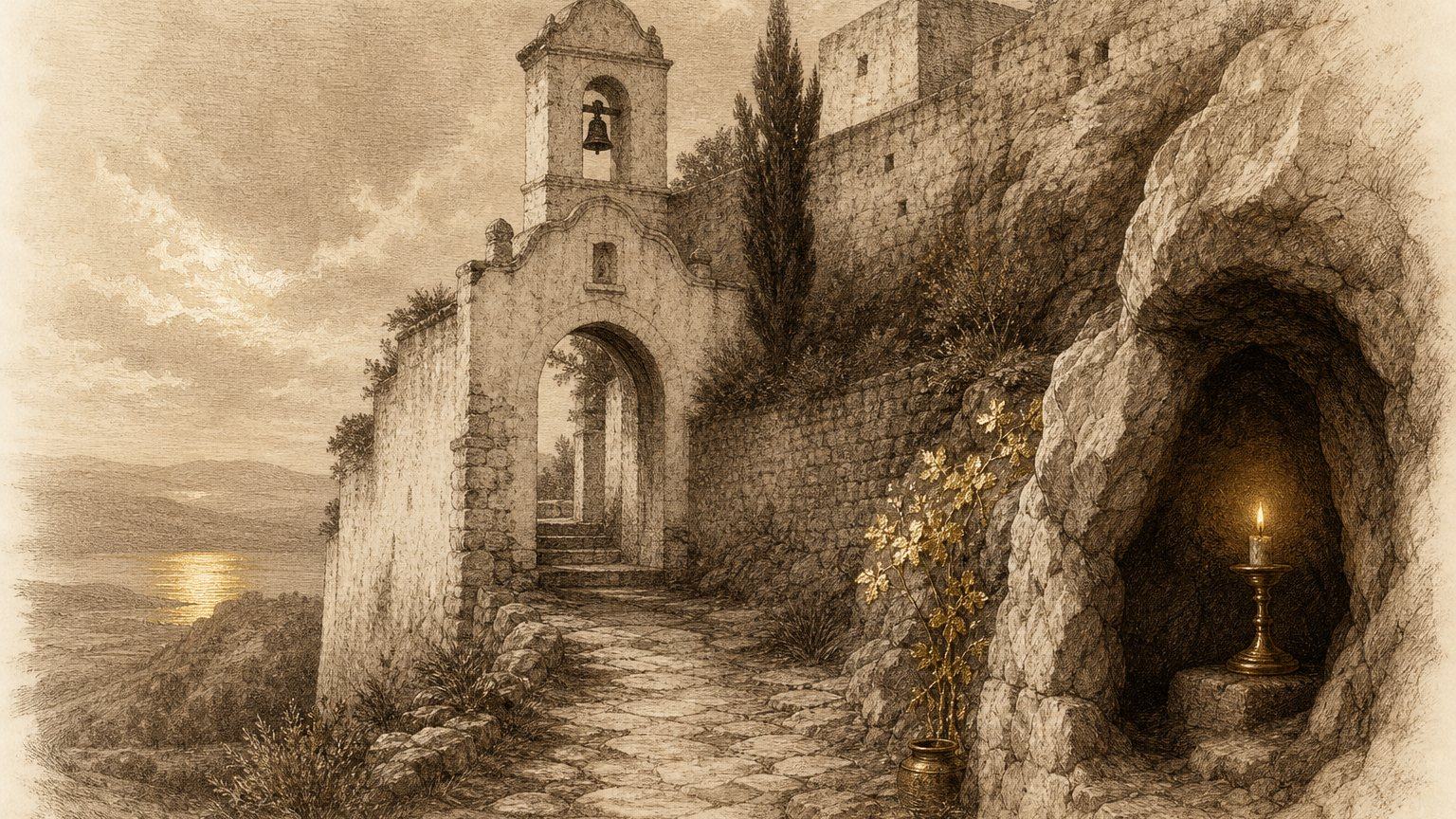
The Holy Dormition Pskov-Caves Monastery (in Russian, Pskovo-Pechersky) lies in the small town of Pechory, in the Pskov region of north-western Russia. It is roughly 50 km west of the city of Pskov and a few kilometres from the border with Estonia. The name of the town comes from the Russian word peshchery, meaning caves, and the caves are the reason the monastery exists at all.
For many Russian Orthodox Christians it is simply “Pechory”, the way Mount Athos is simply “the Mountain” to Greeks: a place of pilgrimage and a school of the monastic life. If you have heard of it through the 2011 memoir Everyday Saints and Other Stories, this article gives the history behind the setting; it does not retell the book.
When and how was the monastery founded?
The traditional date of foundation is 15/28 August 1473, the feast of the Dormition of the Mother of God, when a priest-monk named Jonah (Shesnik) consecrated the first cave church dedicated to the Dormition. The double date reflects the Julian calendar still used by the Russian Church, on which 15 August falls on 28 August of the civil calendar. That church, with a later façade, remains the heart of the monastery.
The monks did not arrive in an empty place. Hermits had been settling in the caves from the middle of the fifteenth century. A cave church made sense in a land of raids and cold winters: the temperature underground changes little, and the rock gave shelter that wooden buildings could not.
A Christian who knows the Psalms will recognise the instinct. “One thing have I asked of the Lord, that will I seek after: that I may dwell in the house of the Lord all the days of my life” (Psalm 26:4, Septuagint numbering listen in the Audio Bible). Monastic foundations across the Orthodox world begin from that single request, and the Pechory story is one example among many. To understand why people make that request, see Why do people become monks and nuns? The psalmist's longing is the same: “My soul longs and faints for the courts of the Lord” (Psalm 83:2 listen in the Audio Bible).
Who was St Cornelius of Pskov-Caves?
St Cornelius became abbot in 1529, at about the age of twenty-eight, and is remembered as the second founder of the monastery. During his abbacy the community grew from roughly fifteen brothers to about two hundred. He enlarged the caves, built the church of the Annunciation (1541) and later the church of the Protection of the Mother of God (1559), and had a stone wall with towers raised around the monastery between the late 1550s and the mid-1560s.
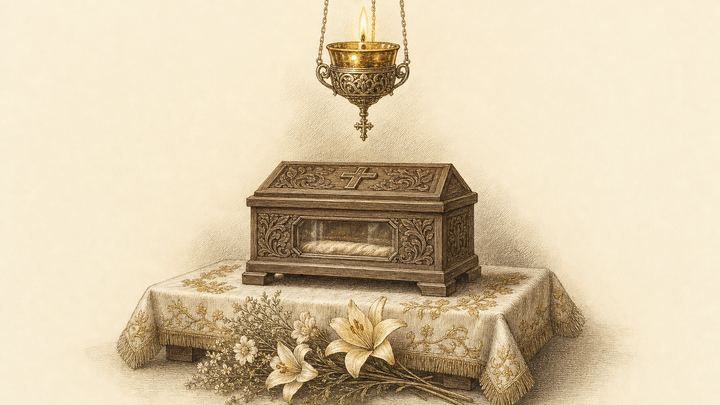
Cornelius is also remembered as a martyr. According to the monastic tradition, Tsar Ivan IV, passing through the region in 1570 on his campaign against the northern cities, had the abbot beheaded at the monastery gate on 20 February, and then, grieved, himself carried the body down the path that came to be called the Bloody Path. The details come to us through the church's own memory and the Pskov chronicles rather than through a neutral eyewitness, and the Church commemorates him as a holy martyr; his relics rest in the Dormition church. The story belongs to the larger Russian theme of the saint who tells a ruler the truth, which returns in the twentieth century, as described in New martyrs and confessors of Russia.
How did the monastery survive sieges and wars?
The walls justified themselves. In 1581-1582 the Polish king Stefan Batory besieged Pskov and the surrounding country, and the monastery held out. In 1611-1616, during the Time of Troubles, Polish and Swedish forces attacked it again. The fortifications were rebuilt in 1701 during the Great Northern War, and only after that conflict, when the frontier moved far to the west, did the monastery lose its role as a fortress.
That conviction is not peculiar to Pechory. In the Orthodox understanding the departed are not absent; the community that prays on earth prays together with those who have gone before. See The communion of saints explained and Why Orthodox Christians pray for the dead for the reasoning behind the long rows of niches, candles and names that visitors find underground.
Why was the monastery never closed in the twentieth century?
After the Russian Revolution, nearly all of Russia's monasteries were closed or turned into prisons, museums and warehouses. Pechory escaped for a reason of geography. Under the Treaty of Tartu in 1920, the town and the neighbouring Seto lands were ceded to Estonia, and the district became Petseri County. For twenty years the monastery lived in an independent Estonian republic in which the monastery could carry on its life.
Estonia was annexed by the Soviet Union in 1940, and the region went through the German occupation of 1941-1944. By the decrees of 23 August 1944 and 16 January 1945 Pechory and the eastern part of the county were transferred to the Pskov region of the Russian Soviet republic. The monastery was therefore under Soviet law from the middle of the 1940s, yet it was not closed, and it is counted today among the few Russian monasteries that have never been closed at any point in their history. It lived under the same restrictions as every other Soviet church, with limited numbers, official surveillance and hostility in the press.
Why it was spared is partly a matter of circumstance: its situation in a border region, its place in the life of the local Orthodox and Seto population, and the late arrival of Soviet rule. Historians would not claim that the whole explanation is known, and the monks themselves tend to speak of Providence rather than administration. The wider background is set out in The Orthodox Church under Soviet rule. The Church's own confidence is the promise that the gates of hell will not prevail against it (Matthew 16:18 listen in the Audio Bible).
Who are the elders of Pechory?
A monastery is measured by its people. In the late twentieth century the most widely known of them was Archimandrite John (Krestiankin), born in Oryol in 1910. He was arrested in 1950 for his pastoral work and spent about five years in labour camps before his release in 1955; he later lived at Pechory, where many wrote to him and came to him for confession and counsel. He died on 5 February 2006, aged 95, and in 2021 the Pskov diocese began gathering material for his possible canonisation.
The monastery is also known as one of the places where the tradition of the spiritual father, the elder (starets), was kept alive through the Soviet years when it had been interrupted almost everywhere else. Elder John's own spiritual children include Archimandrite Tikhon (Shevkunov), who entered the monastery in 1982, the year of his baptism, and later became abbot of the Sretensky Monastery in Moscow; those years are the setting of his memoir. The tradition of eldership is explained in The spiritual father and the elders.
What do the caves and the churches look like today?
The Dormition church is the oldest and the most visited: it houses the wonderworking Dormition icon of the monastery and the relics of St Cornelius. Other churches include the Annunciation, the Protection of the Mother of God, and the church of St Nicholas above the main gate. A stone bell tower, begun in the sixteenth century, rises beside them.
The caves themselves form long underground passages under the hill, and the monks buried their dead in them from the beginning, so that the passages are lined with niches. Visitors walk through them in single file, usually with a small candle, past the places where generations of monks have been laid; the relics of St Mark the hermit are venerated underground. The custom is described in Why the Orthodox venerate relics, and the meaning of the candle in Why Orthodox Christians light candles.
How can I visit, and what should I expect?
Pechory lies about 50 km from Pskov and roughly 340 km from St Petersburg; the monastery maintains a pilgrims' house. Arrange lodging in advance through the monastery or a pilgrimage service, and check current entry requirements for the Russian Federation before planning anything.
Dress modestly, women with a headscarf and a long skirt, men in long trousers; take part in the service if you can, and ask for a blessing before photographing in the churches or caves. A lay visitor is a guest, not a participant in monastic discipline, but he can learn from it. The practical points of pilgrimage are covered in Orthodox pilgrimage: what to expect.
A pilgrimage need not be to Pechory. The prophet saw a day when “the mountain of the Lord’s house shall be manifest on the top of the mountains” (Isaiah 2:2 listen in the Audio Bible), and the Church has always taught that the real place of prayer is the heart, as Christ says of the private room: “pray to your Father who is in secret” (Matthew 6:6 listen in the Audio Bible). If you cannot travel, follow the services of your own parish through the liturgy page or the church calendar, and hear the Psalms in the Audio Bible. The same prayer that burns in the caves is offered wherever the Liturgy is served.