What are the stages of Orthodox monastic life?
Orthodox monasticism does not work like a single ceremony after which a person is simply a monk. The usual pattern is a period as a guest, a time as a novice, and then, traditionally, three tonsures: the first tonsure of the rassophore (the robe-bearer), the tonsure of the stavrophore (the cross-bearer), also called the little schema, and the great schema, also called the angelic habit. The Greek word schema means form or habit, so each stage is literally a new form of clothing and a new form of life.
The gradual path has a plain purpose. The Church assumes that a person who feels a strong desire to leave everything for Christ may not yet know himself or herself, and that the desire has to be tested by ordinary days of work, prayer and obedience. The abbot, or the abbess in a women's monastery, decides when a person is ready for the next step, and no step is a right. Details differ between Greek, Slavic and other monasteries, and this is the general outline. Anyone considering this path should start with a parish priest. For why people choose this life at all, see Why do people become monks and nuns?
The novice: life under obedience before any habit
The Slavonic word for a novice, poslushnik, means one who is under obedience, and the Greek term is closer to "one being tested". After staying in the monastery as a guest for some days, a candidate may be blessed by the abbot to live as a novice. There is normally no formal ceremony and no vow. The novice receives permission to wear simple dark clothing, perhaps an inner cassock and a soft hat, and is often given a prayer rope and taught the Jesus Prayer.
A novice may leave at any time without blame, and the monastery may also ask a novice to go. The work given to a novice is usually humble: kitchen, bakery, laundry, garden, cleaning the church. The point is that the heart learns to act without self-will, a theme explored in What is obedience in an Orthodox monastery? The Lord's call to the rich young man to sell what he has and follow Him (Matthew 19:21 listen in the Audio Bible) is the Gospel background for the whole path, and the novitiate is where the call meets everyday life.
The rassophore: the first tonsure
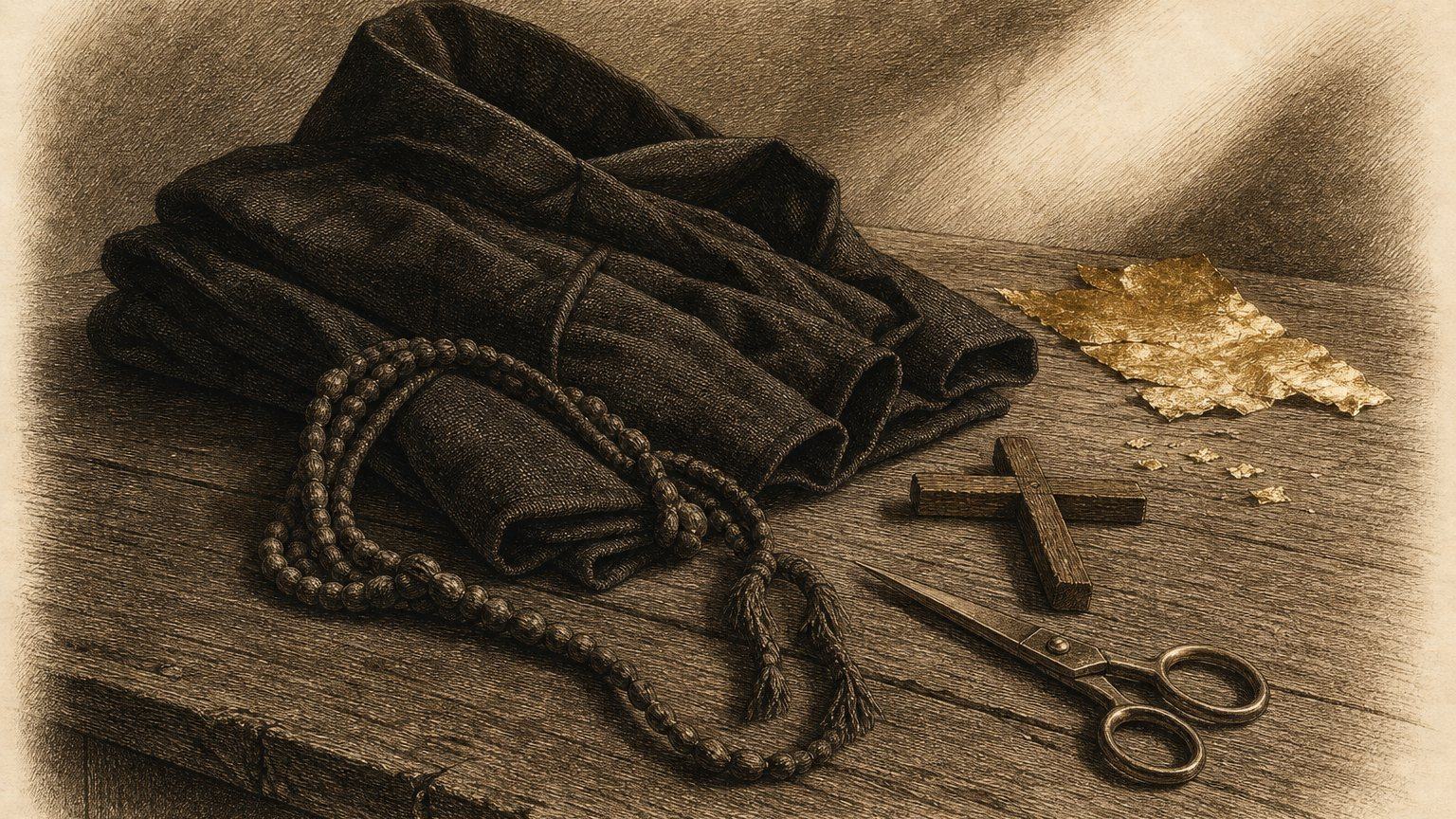
The first tonsure is that of the rassophore, from the Greek rasophoros, one who wears the rason, the outer cassock. The abbot cuts a little hair from the candidate in the form of a cross and clothes him or her in the cassock, the belt and the head covering. In the Russian tradition the brimless cylindrical hat and its veil are sewn together as a klobuk. The colour is black, a sign of renouncing the world's ambitions, not its people, for whom monks and nuns pray.
A new name is given at this stage in many traditions. The practice varies, and in some Slavic houses the name is given at the next tonsure instead, so the safe statement is that a new name accompanies the entry into the monastic life in a form decided by local custom. No formal vows are taken at this stage, though the candidate affirms before the brotherhood a firm intention to persevere, and he or she is understood to be bound in conscience to remain. The Lord's words on taking up one's cross (Matthew 16:24 listen in the Audio Bible) are often connected to this step.
The stavrophore or little schema: where the vows are made
After some years, when the abbot judges the monk to be disciplined, humble and settled, he may be tonsured as a stavrophore. In the Slavic tradition this is the rite many people simply call "the monastic tonsure", and the monk is also vested in the mantle (mantiya), which is why the Russian expression is tonsure "into the mantle". The Greek word stavros means cross, and the monk now wears the paramandyas, a square cloth embroidered with the instruments of the Passion and tied to a wooden cross worn over the heart.
This is the point at which the monastic vows are made: obedience, non-possession (poverty), chastity, and in many traditions stability, that is, remaining in one's monastery. The monk is given a wooden hand cross and a lit beeswax candle, and by custom remains in or near the church for several days of prayer afterwards, three days in many places today. St Paul's confession that he has been crucified with Christ and that Christ lives in him (Galatians 2:20 listen in the Audio Bible) is the spiritual centre of the vow.
The great schema: the angelic habit
The great schema is the highest monastic degree, called "angelic" because it points to a life of continual prayer like that of the angels. Its service follows a similar pattern to the little schema, and the same vows are professed again with greater weight. The monk is clothed with the analavos, a garment embroidered with the instruments of the Passion and the Trisagion, in the Slavic form with a hood, together with the cord of small crosses called the polystavrion.
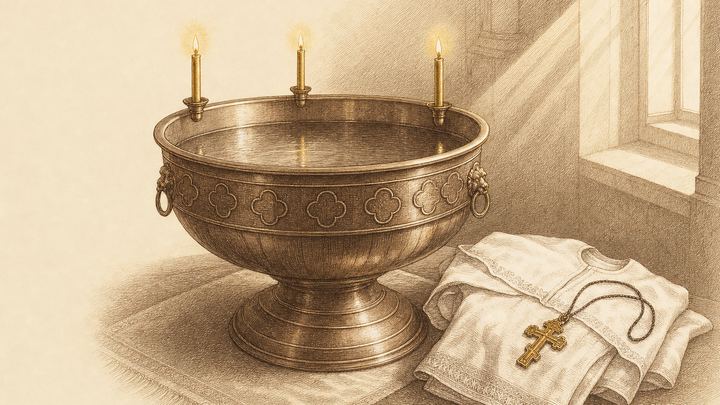
Traditions differ greatly on when this step is taken. On Mount Athos it is often given a few years after the start of monastic life, in some Slavic and other traditions it is given only to monks of long experience, and in some it is given in old age or on the deathbed. Baptism is the pattern for all of this: St Paul describes baptism as being buried with Christ so that we may walk in newness of life (Romans 6:4 listen in the Audio Bible), and the Fathers call monastic tonsure a "second baptism" in the sense of a renewal of baptismal promises, not a replacement for the sacrament. See What happens at an Orthodox baptism.
Monk, hieromonk, hegumen, archimandrite: what is the difference?
These are two separate scales that people often confuse. The monastic scale is the one above: novice, rassophore, stavrophore, schema-monk. The priestly scale concerns holy orders. A monk who has not been ordained is simply a monk. A monk ordained as a deacon is a hierodeacon, and a monk ordained as a priest is a hieromonk, literally a priest-monk. Bishops in the Orthodox Church are chosen from the monastic or celibate clergy, which is why many monastics later become bishops.
Titles such as hegumen and archimandrite refer to administrative or honorary rank among priest-monks. A hegumen is the head of a monastery or a priest-monk honoured with that rank, and an archimandrite is a higher rank usually given to senior hieromonks and to the heads of larger monasteries. A monk of the great schema adds the word schema to his title, so a hieromonk becomes a hieroschemamonk, and an archimandrite a schema-archimandrite.
What happens at a tonsure service, and why is the name changed?
The service of tonsure is a liturgical rite with a recognisable shape. The candidate stands or lies before the abbot and the brotherhood, and is asked a series of questions about what he or she is seeking, whether this is by free choice, and whether he or she will persevere in obedience, chastity and poverty until death. Hair is cut in the form of a cross, new clothes are given one by one with a prayer for each, and the new name is proclaimed.
The name change echoes Scripture, where God renames people at turning points, such as Abram and Simon. It does not mean that the former person is despised. It means that the monastic gives up the right to define himself. The Church's church calendar helps you find the feast of a monastic's patron saint, which monasteries keep as a name day. The whole rite also teaches that the monk takes up a path of constant repentance, as described in Why confess your sins to a priest?
Why the abbot and brotherhood matter in these stages
At every stage the decision belongs to the abbot with the brotherhood, not to the candidate alone. The abbot is called the spiritual father of the monastery, and his task is to judge when a person is ready, to correct, and to bear the burden of the monks' souls before God. The monk, for his part, does not choose his own pace. This is a deliberate protection against pride and against what the tradition calls spiritual deception, treated in What is prelest?, where a person confuses his own plans with the will of God. On guidance more widely, see What is an Orthodox spiritual father?
The monastic stages are also a reminder that holiness does not depend on the habit. If you would like to hear the Church's prayers and the scriptures that shape this life, you can visit a service (see the Liturgy page) or listen to the Gospels and the Psalms in the Audio Bible. Hebrews 13:17 listen in the Audio Bible speaks of those who watch over souls and will give account, a verse often cited about the abbot's responsibility.